

FMECA method and fault tree
The FMEA fault tree represents a powerful methodological combination for anticipating failures, improving safety and enhancing the reliability of industrial installations. Discover how these two complementary approaches can be integrated into your maintenance system to identify each potential failure mode, assess its criticality level and rapidly implement the necessary preventive actions.
In brief
- FMEA and the fault tree are key methodologies for anticipating breakdowns, enhancing safety and optimizing the reliability of industrial plants.
- FMECA identifies failure modes, assesses their severity, frequency and detectability, and is part of a PDCA approach in line with ISO 9001 standards.
- Calculating the RPN (Risk Priority Number) helps prioritize risks and guide preventive actions, while facilitating traceability and continuous improvement.
- Integrating FMEA and fault trees into a CMMS optimizes risk management and boosts the overall performance of industrial systems.
Optimize your maintenance management with a CMMS tailored to your business sector!
Fundamentals of the FMECA method
FMEA (Failure Mode, Effect and Criticality Analysis) is an analysis method that examines each component or function to identify possible failures. It then measures their severity, frequency and probability of detection. This ISO 9001-compliant analysis method is part of the PDCA approach, and forms a solid basis for any preventive maintenance strategy.
Structure and implementation steps
The success ofFMECA analysis in maintenance depends on five essential steps, implemented by a multi-disciplinary team of technical experts, quality managers and operational staff. This collaboration ensures a complete system analysis, and makes it possible to draw up a detailed fault tree for each piece of equipment.
Optimize the integration of FMEA and fault trees in your CMMS:
- Put together a multi-disciplinary team: bring together a variety of profiles to identify potential failures and accurately assess their criticality.
- Analyze the system in depth: Break down its functions, map interactions and prepare the supports needed to study risks.
- Identify all failure modes: methodically list possible causes (wear, overload, human error, etc.) and their impact on the system.
- Quantify risks: Use evaluation grids (severity, frequency, detectability) to prioritize corrective actions objectively.
This approach makes it possible to map risks precisely, document all failure modes and create valuable traceability for future audits, while feeding into the continuous improvement process.
RPN calculation and criticality thresholds
This failure analysis method is based on the RPN (Risk Priority Number), calculated by multiplying the ratings for Severity, Frequency and Detectability, in order to rank risks according to their priority. For example, a leak on a hydraulic cylinder rated G8, F3 and D2 gives an RPN of 48, indicating a significant criticality requiring rapid action.
Each industrial sector defines its own intervention thresholds: an RPN above 100 requires immediate corrective action, while a score between 40 and 100 triggers programmed preventive measures. High-risk industries such as aeronautics and nuclear power generally apply stricter criteria to guarantee optimum safety.
Digital integration into CMMS
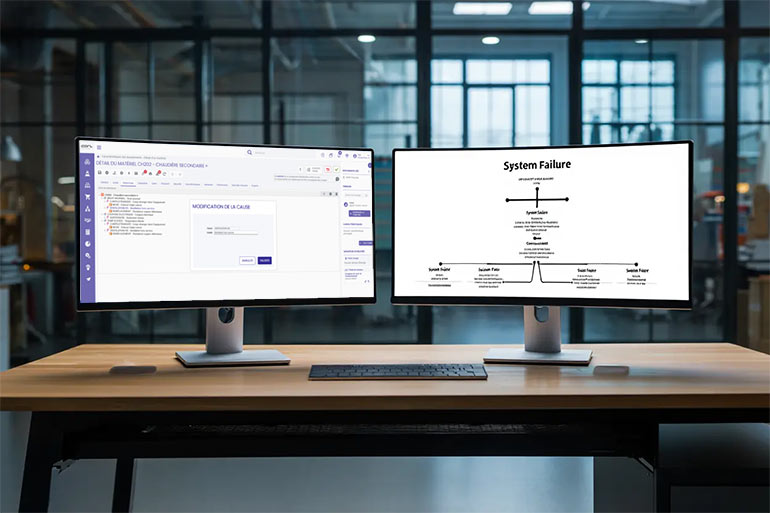
In a modern CMMS, the FMECA module fully integrates this method into the maintenance system: assisted input of parameters, automated calculation of RPN and generation of preventive or corrective work orders. Each update enriches the knowledge base, improves early detection of problems and enhances overall plant reliability.
The history of interventions enables continuous adjustment of severity, frequency and detectability parameters, updating each fault tree. Dashboards display average RPN, residual criticality and failure mode frequency in real time, providing a precise view of the effectiveness of the measures implemented.
Fault tree: risk analysis and quantification
The Fault Tree Analysis (FTA) method adopts a top-down approach, starting from a target undesirable event and exploring its root causes. This technique provides a visual representation of the various combinations of elementary failures that could lead to a critical incident, thus revealing a system‘s potential weaknesses.
Logic construction and combinatorial gates
The first step is to define the “top event”, i.e. the feared event (such as a production stoppage or an accident). The analysis then breaks down this scenario into intermediate causes, then into observable elementary failures. Logic gates (AND, OR) structure these relationships:
- An AND gate requires the simultaneous occurrence of all its inputs
- An OR gate is triggered by a single cause
Let’s take the example of a breakdown on a production line: three main causes can be linked by an OR gate (faulty motor, sensor failure or operational error). The “motor” branch could itself be broken down into sub-causes combined by an AND gate (mechanical wear AND overheating), creating a complete tree of failure scenarios.
The XOR (exclusive OR) gate is used to model mutually exclusive situations. This operator is particularly useful in complex industrial systems, where interactions between components generate risk dynamics that are difficult to anticipate.
Probabilistic quantification and critical paths
Top-down risk analysis is based on quantitative data:
- Probabilities of elementary failures (derived from maintenance history).
- Specific calculations according to logic gates.
- AND gate: product of probabilities.
- OR door: 1 – product of (1 – probabilities).
This approach identifies the most critical paths in the fault tree.
Implementation in maintenance software
Modern software solutions such as CARL Source Factory automate the creation of fault trees:
- Generation from intervention histories.
- Intuitive visual interface with library of standard elements.
- Customization and validation of causes and associated remedies, ranked in order of probability.
The results directly guide preventive maintenance plans to improve overall reliability.
FMEA and fault tree: differences and complementarity
These two approaches torisk analysis have opposing rationales, but complement each other perfectly when it comes to improving industrial reliability. A good grasp of their particularities enables you to select the right method for each situation, and to achieve complete coverage of failure modes, whether isolated or combined.
Bottom-up versus top-down approaches
The main difference between FMECA and Fault Tree lies in the way they are analyzed.FMECA follows a bottom-up logic: it starts with the components and works up to the system consequences, calculating an RPN for each failure. In contrast, FTA (fault tree analysis) takes a top-down approach: it starts with the feared event, identifies its possible causes and estimates its overall probability.
Knowing how to generate your fault trees from a FMEA facilitates the synergy between these two approaches at the heart of your maintenance system.
- FMEA: a detailed analysis
It screens each component, assesses the severity, frequency and detectability of failures, and classifies actions according to their level of criticality. - FTA: An overview
It maps failure sequences, highlights cascading effects and quantifies the probability of systemic events. - A natural complementarity:
FMEA feeds the fault tree with precise data, while the fault tree reveals critical scenarios invisible in an isolated analysis.
This duality reflects two risk management philosophies.FMECA is based on systematic prevention through targeted actions. FTA protects against catastrophic scenarios where several simultaneous failures threaten the safety of the installation.
FMEA and fault tree comparison table
| Criteria | FMECA | Fault tree |
|---|---|---|
| Analysis direction | Bottom-up | Top-down |
| Main focus | Individual failure modes | Combinations and interactions |
| Key indicator | RPN (Severity × Frequency × Detection) | Probability of top event |
| Ideal phase | Design, commissioning | Post-incident analysis, complex systems |
| Main output | Targeted preventive action plan | Critical paths and minimum cuts |
Selection criteria according to context
The choice between these two methods depends on the complexity of the installation, the data available and the regulatory framework. Their complementarity often offers the optimum solution for a comprehensive risk analysis.
- System complexity: FMECA is sufficient for simple equipment; a complex system requires FTA to model combinations of failures.
- Available data: FMECA works with qualitative estimates; FTA requires precise probabilities to quantify scenarios.
- Regulatory requirements: the aeronautics and nuclear sectors often impose FTA, whereas ISO 9001 favors FMECA.
- Team skills: FMECA requires business experts; FTA requires skills in Boolean logic and system reliability.
During the design phase, FMECA identifies all potential failure modes and draws up a maintenance plan. This approach improves safety and reliability before start-up.
After an incident, the FTA reconstitutes the causal chain, revealing systemic flaws that a simple FMEA could not detect. This analysis reduces the frequency of serious accidents.
“We needed a market solution with a robust standard, supported by a reliable and scalable publisher. CARL Software’s reputation and the quality of its support convinced us…”
Practical applications and FMEA-FTA best practices
The combined use of these two approaches brings tangible benefits in terms of availability and safety, while reducing maintenance costs. This methodological synergy is a formidable tool for improving reliability and controlling risk in critical systems.
The examples below illustrate how different industries useFMECA and FTA to optimize criticality, estimate probability of failure and define their predictive maintenance strategy, taking into account their specific needs.
Concrete examples by business sector
FMECA-FTA use cases demonstrate the universal applicability of this method to all industrial sectors. In the manufacturing sector, an FMECA analysis of a centrifugal pump reveals “bearing wear” as the main failure mode: with G=8, O=3 and D=1, the RPN reaches 24. This leads us to schedule preventive replacement every five months or 3,000 hours of use, with advance stock management to avoid any shortages.
- Data-center – Critical air-conditioning system: The critical event “loss of cooling” is modeled via a fault tree. Compressor failure (probability 0.02), a fluid leak (0.015) or a faulty thermostat (0.01) result in a cumulative probability of 4.5%. The action plan includes reinforced quarterly inspections and redundancy of the main circuit.
- Water treatment – Municipal plant: The FMEA identifies leaks at the dosing pump seal(criticality 18). The FTA combines this potential failure with contamination of the basin via an ET door, revealing a critical scenario requiring preventive replacement of the seal and weekly bacteriological monitoring.
- Healthcare – Hospital elevator: After identifying failure modes using FMEA, the FTA includes a power failure to assess the probability of a complete shutdown. These analyses justify the installation of a generator and battery backup system, essential for patient safety.
In the food industry, the main “line stop” event results either from drive failure, or from a combination of drive failure AND cooling problems. This analysis shows that simple sensor replacement is ineffective unless the cooling system is stabilized. The company is therefore adapting its predictive maintenance with monthly thermography and quarterly cleaning.
Decision factors and implementation
The success of a FMEA-FTA project depends as much on the organization as on the techniques employed. A multi-disciplinary team (engineering, maintenance, quality) pools its knowledge and feedback to cover all failure modes and ensure compliance with standards.
Criticality thresholds (RPN) and acceptable probability levels are adapted to the risk and financial impact: critical equipment will limit the annual probability to 0.001%, while a production machine may tolerate 5%. The PDCA approach enables continuous improvement: planning, deploying preventive actions, checking reliability indicators, then updating the FMEA-FTA method.

Discover also

Grand Chambéry: CARL Source CMMS at the heart of a sustainable performance strategy
At the heart of Grand Chambéry's territory, the water and wastewater department is responsible for preserving an essential resource: water. Responsible for the management and maintenance of facilities and networks in 38 communes, the department faces major challenges: guaranteeing efficient distribution, optimizing yield and preserving the environment through ever more efficient wastewater systems. To support [...]
CARL Software deploys Artificial Intelligence for Maintenance 5.0
At the Global Industrie trade show, CARL Software, a subsidiary of the Berger-Levrault group, will be presenting its solutions enhanced by artificial intelligence and connected by the IoT. CARL Software, specializing in CMMS (Computerized Maintenance Management Systems) and EAM (Enterprise Asset Management), is number one in France and among the European leaders. With 40 years [...]
CARL Software at Global Industrie 2026: heading for Maintenance 5.0 with AI and IoT
From March 30 to April 2, 2026, CARL Software, the French leader in CMMS and EAM, invites you to visit us at the Global Industrie 2026 trade show in Paris Villepinte. Meet our teams and those from BL.Predict, an IoT platform dedicated to predictive maintenance, at the Digital Technology Village – Hall 5A – Booth [...]
