Attend a demonstration
Would you like to find out more about our CMMS solutions?
Book your demonstration today!
Would you like to find out more about our CMMS solutions?
Book your demonstration today!

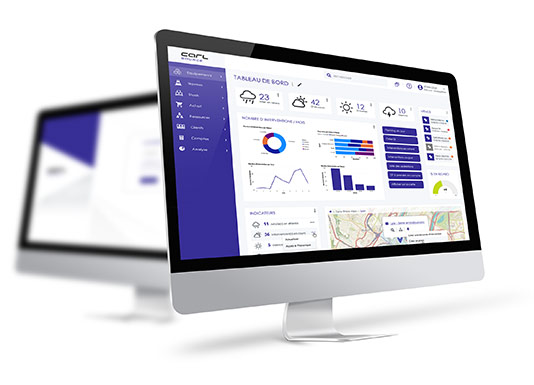
The acronym CMMS stands for: “Computerized Maintenance Management System”. CMMS software is an IT solution that enables the planning, tracking, and optimization of maintenance operations for a company, organization, or local government. It centralizes information on equipment, maintenance work, inventory, and teams to improve efficiency and reduce maintenance-related costs.
High-performance CMMS software optimizes maintenance and asset management through several essential features, such as:
Agri-food, water and wastewater, real estate, retail, transport, hospitals… CARL Source CMMS adapts to your organization’s size and sector of activity.
Equipment life cycle – GIS cartography, DWG drawings, 3D models – Predictive maintenance – Mobility – Personalization and authentication – Corrective and preventive maintenance – Work and resources planning – Managing fixed and linear assets – Interfaces and interoperability – Regulatory maintenance – Internet of Things, artificial intelligence – Services portal – Reporting and analysis – Internal resources and subcontracting.
Structure your equipment.
Carry out maintenance work.
Organize internal resources.
Manage purchasing and optimize inventory management.
Analyze activity.
| Benefit | Description |
|---|---|
| Réduction des pannes | Anticipation des défaillances grâce à la maintenance préventive |
| Gain de temps | Automatisation des tâches répétitives |
| Maîtrise des coûts | Optimisation des stocks et des interventions |
| Traçabilité | Historique complet des interventions |
The Benefits of Augmented Maintenance.
Calculate your return on investment (ROI) with our online simulator.
Calculate your ROI on your maintenance operations
With the CARL Source range of CMMS (Computerized Maintenance Management System) and TAM (Technical Asset Management) software, you can optimize the operation and maintenance of your buildings, equipment and networks (preventive maintenance, , cost control, energy performance, occupant well-being, etc.).
Predictive maintenance is an approach to maintenance management that involves anticipating maintenance needs of a piece of equipment, a system or a facility, based on data history, degradation models, performance analysis and other technical diagnostics. The main objective of predictive maintenance is to proactively plan and carry out maintenance work before a failure occurs, in order to reduce unplanned downtime and optimize operational efficiency.
With this in mind, we have developed our IoT platform dedicated to predictive maintenance: BL.Predict.
This maintenance solution manages the entire IoT chain, from data collection by sensors to their use in CMMS. It provides technical departments with the predictive data they need, to effectively plan preventive maintenance and optimize equipment operation.
With its mobile offering, CARL Source CMMS meets the new needs of digital maintenance.

Service request application for managers of a property, facility or public space.
Attend a demonstration or ask for more information about our Mobile CMMS solutions.
CMMS stands for Computerized Maintenance Management System. It refers to a management software solution for the technical or maintenance departments of companies, establishments or local authorities.
CMMS software can be used to manage, control and identify all technical assets, and run all business processes of technical departments that use this type of solution.
These include Maintenance work management, stock management, etc.
The first objective of setting up a CMMS is to know your technical assets.
Whatever the sector of activity, whatever the type of maintenance, it must be identified, mastered and updated.
The second objective of CMMS maintenance management is to be able to manage your maintenance activities. Which technician carries out which Maintenance work, when and where?
Finally, the third objective of implementing a CMMS is to be able to analyze dashboards to control and steer maintenance activity in the future. By providing clear indicators, CMMS facilitates decision-making.
All these factors mean that a CMMS offers solutions for increasing efficiency. By digitizing all existing paper-based processes, it centralizes information and makes it accessible to as many people as possible.
FMECA method and fault tree The FMEA fault tree represents a powerful methodological combination for anticipating failures, improving safety and enhancing the reliability of industrial installations. Discover how these two complementary approaches can be integrated into your maintenance system to identify each potential failure mode, assess its criticality level and rapidly implement the necessary preventive [...]
What are the different types of maintenance and their impact on asset performance? Maintenance plays a central role in equipment performance, availability and durability. Understanding the different types of maintenance enables us to structure a strategy adapted to operational and economic challenges. Supported by CMMS, this approach transforms maintenance into a real asset management lever. [...]
Artificial intelligence in maintenance services. If we had to name one theme that has dominated IT news in recent months, everyone would agree on artificial intelligence. Since the release of ChatGPT 3 at the end of 2022, AI and more specifically generative artificial intelligence (Gen AI), have become technologies within everyone's reach. But even [...]