

What are the different types of maintenance and their impact on asset performance?
Maintenance plays a central role in equipment performance, availability and durability. Understanding the different types of maintenance enables us to structure a strategy adapted to operational and economic challenges. Supported by CMMS, this approach transforms maintenance into a real asset management lever.
In brief
- The different types of maintenance (corrective, curative, preventive and predictive) complement each other to manage asset performance.
- The choice of strategy depends on equipment criticality, service continuity and cost control.
- CMMS structures the management of equipment, maintenance work and maintenance data.
- Using data to anticipate failures, optimize investments and extend asset life.
Optimize your maintenance management with a CMMS tailored to your business sector!
Corrective maintenance
Responding to faults
Corrective maintenance is triggered after a fault has occurred.
It restores equipment operation, but can cause unplanned downtime.
It remains relevant for :
- Low-critical equipment.
- Redundant assets.
- Situations where the cost of failure is low.
A CMMS helps reduce the impact of this type of intervention by speeding up the management of requests, work orders and downtime tracking.
Curative maintenance
Correcting faults
Curative maintenance consists of repairing faulty equipment in order to correct the malfunction and prevent it from developing into a complete breakdown.
It is somewhere between corrective and preventive:
- The equipment is still partially operational.
- The aim is to eliminate the cause of the defect.
- It limits the risk of future deterioration.
Preventive maintenance
Plan upstream actions
Preventive maintenance is based on anticipated interventions, according to a calendar, usage cycles or wear indicators.
The aim is simple: to limit failures by intervening before they occur.
In particular, it enables :
- Better resource planning.
- Reduced risk of unplanned downtime.
- More stable budget control.
With a CMMS capable of managing preventive maintenance, teams can automate schedules, track intervention histories and anticipate spare parts requirements.
Predictive maintenance
Anticipating failures
Predictive maintenancealso known as condition-based maintenance, is based on monitoring the actual condition of equipment.
It uses sensors (temperature, vibration, pressure, consumption, etc.) and data analysis to detect early signs of failure.
It allows you to :
- Intervene at the right moment.
- Maximize availability.
- Reduce long-term costs.
- Extend asset life.
Thanks to the analysis capabilities of a modern CMMS, decisions are based on operational indicators such as mean time between breakdowns or mean time to repair.

Today, maintenance is no longer seen as a simple support function, but as a key player in industrial performance…
The benefits of each approach
Promoting safety and extending equipment life
Each type of maintenance contributes in its own way to overall performance:
- Corrective: simple interventions in non-critical contexts.
- Curative: rapid elimination of malfunctions before they worsen.
- Preventive: increased reliability and controlled planning.
- Predictive: maximum availability and lifecycle optimization.
By intelligently combining these approaches and relying on CMMS, organizations can enhance safety, reduce risk and extend the life of their equipment over the long term.
Maintenance costs
Optimizing costs
Each type of maintenance has a different budgetary impact:
- Corrective action exposes you to unforeseen costs.
- Preventive measures stabilize expenditure.
- Predictive technology requires an initial investment, but optimizes costs over the long term.
- The curative approach avoids aggravating minor defects.
The challenge is to build a strategic mix adapted to equipment criticality and performance objectives.
Maintenance comparison chart
| Maintenance type | Intervention principles | Main objective | Impact on service continuity | Overall cost (long-term approach) | Major benefits | Main limits |
|---|---|---|---|---|---|---|
| Corrective | Troubleshooting | Restore operation | High risk of interruption | High cost if frequent breakdowns | Simplicity and responsiveness | Unpredictability, loss of service |
| Curative | Correction of an identified fault before complete breakdown | Removing the cause of failure | Reduced risk of unplanned downtime | Cost effective, avoids major repairs | Prevent major failures, improve reliability | Requires early detection of anomalies |
| Predictive / conditional | Actions based on actual conditions | Acting at the right time | Minimize unplanned downtime | Initial investment but high ROI | Optimization of resources, longer service life | Need for sensors and data analysis |
| Preventive | Planned interventions | Reduce the risk of breakdown | Controlled continuity, planned shutdowns | Stable, predictable costs | Greater reliability, compliance | Interventions sometimes unnecessary |
Build a strategy by impact zone
The ideal maintenance strategy is based on an intelligent mix of corrective, preventive and predictive approaches. By analyzing the criticality of assets, we can choose the right level of intervention along four axes:
- Service continuity: prioritize availability through preventive or predictive maintenance.
- Budget control: balance operating and investment costs.
- Safety and compliance: anticipating regulatory and technical risks.
- Equipment durability: extend the life of assets and plan replacements.
The key role of CMMS in maintenance strategy
Equipment and service management
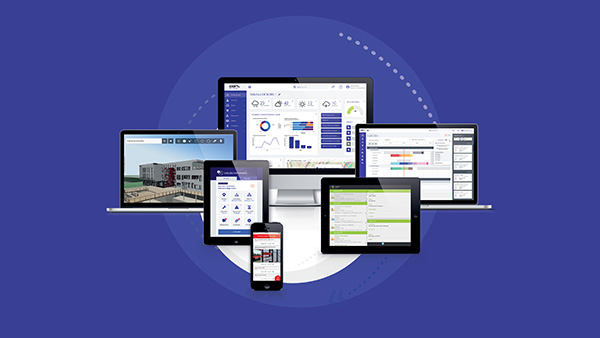
A CMMS (Computerized Maintenance Management System) centralizes all the information required to implement an effective maintenance strategy. It provides a single platform for managing equipment, interventions and associated resources.
Thanks to CMMS, teams can organize and plan maintenance operations, track equipment status and history, manage spare parts inventories and analyze overall maintenance performance, particularly in terms of costs, availability and reliability. These functionalities provide a structured and coherent vision of maintenance activity.
Today, maintenance data plays a central role in improving asset performance. By analyzing service history, failure trends, service times, associated costs and main failure modes, it is possible toidentify areas for improvement and equipment reliability. CMMS transforms this data into continuous improvement levers, making it easier to prioritize actions and investments.
Solutions like CARL Source help organizations make the transition from essentially reactive maintenance to data-driven maintenance. Relying on consolidated, usable information, maintenance managers have decision-making tools aligned with operational challenges and overall performance.
Conclusion
The different types of maintenance are not in conflict with each other: they complement each other.
The key lies in the right balance between reactivity, prevention and anticipation, supported by appropriate digital tools.
By relying on a high-performance CMMS like CARL Sourceorganizations can transform maintenance into a lever for sustainable performance and value creation.
Customer success stories
Read testimonials from CARL Source CMMS users
Discover also

CARL Software deploys Artificial Intelligence for Maintenance 5.0
At the Global Industrie trade show, CARL Software, a subsidiary of the Berger-Levrault group, will be presenting its solutions enhanced by artificial intelligence and connected by the IoT. CARL Software, specializing in CMMS (Computerized Maintenance Management Systems) and EAM (Enterprise Asset Management), is number one in France and among the European leaders. With 40 years [...]
CARL Software at Global Industrie 2026: heading for Maintenance 5.0 with AI and IoT
From March 30 to April 2, 2026, CARL Software, the French leader in CMMS and EAM, invites you to visit us at the Global Industrie 2026 trade show in Paris Villepinte. Meet our teams and those from BL.Predict, an IoT platform dedicated to predictive maintenance, at the Digital Technology Village – Hall 5A – Booth [...]
CARL celebrates 40 years of growth and innovation
Founded in Lyon, CARL a subsidiary of Berger-Levrault, France's leading publisher of software dedicated to industrial and facility maintenance management is celebrating its 40th anniversary this year. Building on its expertise, the company is continuing its growth trajectory in France and internationally, while integrating the most advanced technologies, such as artificial intelligence and augmented reality. [...]
